17 July 2016

Wildflower - Toadflax

Toadflax (Linaria vulgaris), also known as butter-and-eggs, is native to Europe but is another wildflower that has naturalized its self into most of North America. Toadflax hasn't become an invasive wildflower since it prefers dry banks, roadsides and sandy/gravelly soil.


The Toadflax plants are between 1 and 2 feet tall with flowers that are similar to those of the snapdragon.

16 July 2016

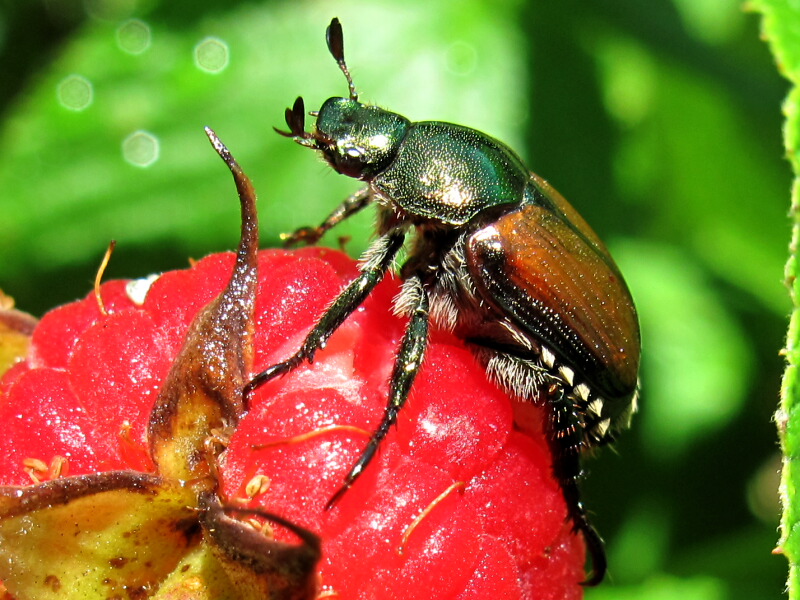
Japanese Beetles

The Japanese Beetles have returned for their annual raiding and pillaging of neighborhood crops. The Japanese Beetle was first discovered on nursery stock in New Jersey almost a century ago. It is now found in most states east of the Mississippi River.

Japanese Beetles feed on a large range of hosts, including leaves and fruit of my raspberries.


When the Japanese Beetles aren't raiding and pillaging the neighborhood crops, they are engaged in debauchery to create next year's ravenous horde.

15 July 2016

Wildlife Wrangling (Part 2)

Another day and another raccoon in the trap. This is the third raccoon from this spot in back of the barn. The first two raccoons were very passive and easy to deal with, this one must have been part Tasmanian devil. This raccoon was released at the same location as the second raccoon.


I've had an inferred game camera aimed at the trap and I checked the photos today. It appears that while the second raccoon was in the trap another raccoon (most likely #3) was also at the trap. This game camera photo shows the door on the trap closed and a raccoon on top of the stack of cement blocks.


As I stated at the beginning, I placed the trap behind the barn to catch a pesky woodchuck. This photo from the game camera shows the woodchuck standing next to the trap while raccoon #3 is in the trap. Maybe the woodchuck has learned more about the trap than the raccoons did. As of this afternoon, the woodchuck was behind the barn playing "Peek-a-Boo" with me.

14 July 2016

Wildlife Wrangling

I've been playing "Peek-a-Boo" with a young woodchuck at our barn for the past couple of weeks. I put out a trap for the woodchuck and found something tripped the trap and moved the empty trap 35 yards from where I had placed it.


For day #2 I chained the trap to a 12 inch cement block and had some more success. I didn't catch the woodchuck but did catch a raccoon.


The raccoon was relocated to a new location several miles from our barn.


Day #3, same trap setup and same result ... Another raccoon. This raccoon was relocated to a different location than the first raccoon.


Still trying to catch the woodchuck.

13 July 2016

Small Milkweed Bug

While photographing some Orange Milkweed (Butterflyweed) flowers I found several Small Milkweed Bugs (Lygaeus kalmii) hidden within the clusters of small flowers. Small Milkweed Bug is the common name for this insect and not just a description of the insect.


The Orange Milkweed flowers are perfect camouflage for this orange and black insect.


Milkweed bugs have few predators because they concentrate in their bodies bad tasting compounds found in the sap of milkweed plants. The bugs use their bright colors to advertise their bad taste.


11 July 2016

Wildflower - Butterfly Weed

When a wildflower has a common name that includes the word "weed" it brings the connotation of an uncontrollable/undesirable plant, but Butterfly Weed (Asclepias tuberosa) would be a fine addition to any garden. The bright orange flowers are hard to miss and unlike most "weeds", the Butterfly Weed does not propagate easily. I only have one clump of Butterfly Weed on our property, and I put a support cage around it so it doesn't get mowed. This plant favors dry, sand or gravel soil, and requires full sun.


Also known as Orange Milkweed, its small 5 lobed flowers glow in clusters and the small flowers are the same shape and size as Common Milkweed.


This plant gets its name from the butterflies it attracts with its bright, nectar rich flowers. This cluster of flowers was covered with small ants.


Wildflower - Common Mullein

The Common Mullein (Verbascum thapsus) is starting to bloom. The flowering stem is erect, rigid, up to 8 feet tall, and covered with woolly, branched hairs. Leaves are densely covered on both sides with hairs giving them a frosted appearance and a flannel-like texture.


The sulfur-yellow petals form a 5-lobed saucer-like shaped flower that is less than 1 inch in diameter. An individual plant produces 100,000 to 180,000 seeds.


Common mullein is a native of Eurasia that was brought into North America by early settlers. Once introduced, it apparently spread rapidly. Common mullein is usually found in disturbed areas such as roadsides, fence rows, old fields and pastures. It prefers to grow on dry and stony soils.

10 July 2016

Wildflower - Moth Mullein

The Moth Mullein (Verbascum blattaria) is starting to bloom in the neighborhood. The common name 'moth mullein' comes from the curved furry stamens that resemble moth's antennae.


Flowers occur on the ends of the erect flowering stems that are produced during the second year of growth. Individual flowers are yellow to white in color, usually with some tinge of purple within.

Moth mullein is a native of Eurasia that was introduced into the eastern coast of North America and then spread west. It reached Pennsylvania by 1818.

09 July 2016

Heat Wave

Our local weather forecaster has declared our current weather as a "Heat Wave" due to 3 consecutive days with the temperature at or above 90F. My weather station recorded a high of 91.8F today.

It was hot today and at midday I watch a deer walk briskly up the road to our cabin, then disappear over the crest of the hill. I drove to the cabin and found the deer had headed directly to our pond to cool off.

08 July 2016

Wildflower - Basswood

The Basswood trees (Tilia americana), also known as the American linden tree, are in full bloom in the hedgerow behind our barn. The 5-petaled fragrant, yellow-white flowers grow in small clusters. The basswood trees in our neighborhood bloom about every other year and it's hard to miss the perfumed air when the flowers are in bloom.


Honey bees and other nectar loving insects are attracted to the fragrant flower and thousands of wild honey bees were attracted to our trees.


A distinctive feature of the basswood is the tongue-like bract (a modified leaf) attached to each cluster of flowers. This leaf is lighter in color than the other leaves and has a dramatically different shape. No other tree in North America bears anything like it. In the fall the flowers in the clusters will be replaced with with the basswood seeds and bract leaf will break loose and the wind will carry the seeds away from the tree.

07 July 2016

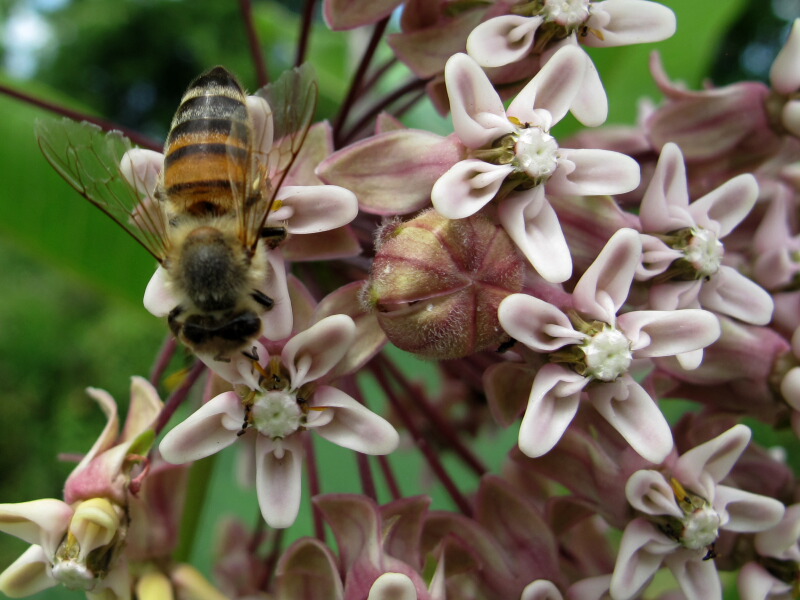
Milkweed and Bees

I'm starting to keep track of the time of year by which wildflowers are in bloom. We're in the early days of milkweeds now.

Most people associate milkweed with the Monarch Buttery but it attracts many insects with its large clusters of tiny five lobed flowers. Here are a few photos of bees (mainly wild honey bees) on milkweed flowers.


06 July 2016

Red Milkweed Beetles

The milkweed plants are starting to bloom in the neighborhood, and they are swarming with different insects. While some insects, such as bees are after the flower's nectar, other insects like the Red Milkweed Beetles (Tetraopes tetrophthalmus) are able to eat the toxic milkweed plant.


Adult Red Milkweed Beetles eat milkweed leaves, buds, and flowers. Like some other milkweed leaf feeders, they sever leaf veins “upstream” of their feeding site in order to minimize their exposure to the milkweed’s sticky latex.

04 July 2016

Wood Frog

I never know what I'll find as I wander the neighborhood. Today's find was a Wood Frog (Lithobates sylvaticus). Most frogs are commonly found near water but the Wood Frogs spend a lot of time on land, the toes on their front legs are not fully webbed. It has been very dry this year and I found this Wood Frog at the edge of our woods.


The Wood Frog is most easily recognized by its "robber mask." This black band stretches past both eyes to the eardrums. They also have dorsolateral ridges, two raised lines running down their back.

Adult Wood Frogs are usually brown, tan, or rust-colored, and are easily camouflaged into the leaf litter.


Wood Frogs are one of the first frogs to breed in early Spring. Their calls, which sound like a "quack," can be heard around water that's near woods.

03 July 2016

Baby Barn Swallows

I was in the upper level of our barn and had a couple of Barn Swallows "dive bomb" me. I stated looking and found the bird's nest tucked up in some rafters on top of an electrical box.


As I was taking some photos one of the parents arrived (at the left) with a mouth full of insects to feed the chicks. The parent was only about a foot from my camera.


In between the feedings the 5 baby birds would rest.


The parents on an old hay lift rope. The female is on the top and the male is on the bottom.

02 July 2016

Fawns

The neighborhood fawns are getting bolder and easier to find along the edge of the road. This fawn, and its twin that wouldn't pose, were along the road to our cabin ...


But mother was close by.


This fawn crossed the driveway to our cabin and then stood in the tall weeds to watch me.