20 October 2019

Safari Day 5 - Aberdare & Lake Nakuru National Park

There wasn't much activity at the watering hole during the night but around 3:00AM we were awakened by a group of 6 hyenas outside our window. In the morning this large forest hog was grazing outside the window.


This young bushbuck made an appearance at the watering hole, as it headed to the salt lick.


After breakfast we board a small bus and head down the dusty park road to return to the Aberdare Country Club to reunite with our tour guides.


Mt. Kenya in the distance.


We pack our luggage into the Land Cruiser at the Aberdare Country Club and prepare for our next stop, Lake Nakuru National Park.


The Aberdare Country Club peacocks give us a sendoff.


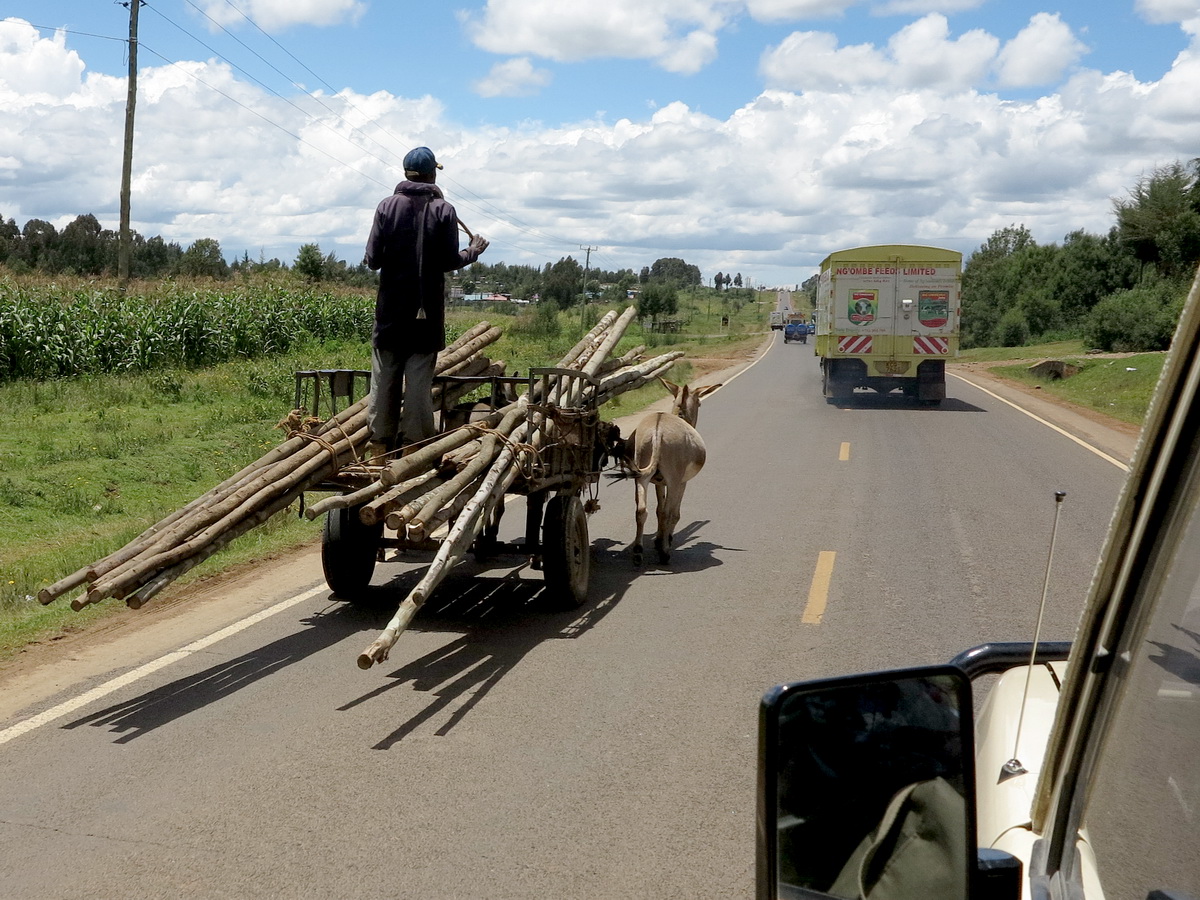
As we travel to Lake Nakuru National Park we pass through the Kenyan farmland.


This area is noted for growing red onions and other vegetables. Our tour guide stopped and bought some garlic at one of these roadside stands.


A truckload of cabbage headed for the market in the town of Nakuru.


We pass back and forth across the Equator at least 3 times on todays travels.


A Cape Buffalo skull at the entrance to Lake Nakuru National Park.


Time for lunch at the Sarova Lion Hill Game Lodge, located within Lake Nakuru National Park.


Sarova Lion Hill Game Lodge overlooks Lake Nakuru.


A weaverbird nest next to the restaurant.


After lunch it was time for a game drive around the Park where we hope to see some of the 25+ eastern black rhinoceros. The Park also has around 70+ southern white rhinos. We soon found these Helmeted Guineafowl.


Grant's zebra, the smallest of six subspecies of the plains zebra.


Water monitor lizard


A large herd of Cape Buffalo along the shore of Lake Nakuru.


We move in closer to the lake and the Cape Buffalo.


Lake Nakuru is home to large concentrations of flamingos due to its abundance of algae. Lake Nakuru is a very shallow in an endorheic basin (limited drainage basin) which causes warm alkaline waters that produce the algae.


A tower (group) of Rothschild's giraffes.


The Rothschild's giraffe is one of the most endangered distinct populations of giraffe, with 1,669 individuals estimated in the wild in 2016. In the center of this photo is a new born Rothschild's giraffe.


This baby Rothschild's giraffe is only a day or two old and still has the umbilical cord still attached.


Giraffes eating leaves from the thorny acacia trees.


A troop of Baboons with Zebra and Impala in the background.


A large male baboon.


A female baboon with a young one on her back.


A Secretary Bird (Sagittarius serpentarius). These are very large birds with an eagle-like body and crane-like legs. They can reach a height of over 4 feet tall.


We find some male Impala as we continue to look for the rhinos.


Finally at the end of the game drive we spot two rhinos far in the distance, in a swampy area. The rhinos are in the middle of the photo.


Following our game drive at Lake Nakuru National Park we are back on the road heading for the Great Rift Valley Lodge at Lake Naivasha.

Along the drive I noticed this unusual cloud formation that resembled a face with pointy ears (or the Pointy Haired Boss from the Dilbert comic strip)


The view from our room at the Great Rift Valley Lodge.

17 October 2019

Safari Day 4 - Aberdare National Park

After lunch at the Aberdare Country Club we pass by some of the high end homes in Muiga as we head for Aberdare National Park.


The entrance sign to Aberdare National Park and a warning.


The vegetation along the park road is very dense but we soon find our first Cape Buffalo.


A few more miles of the park's road and we catch a glimpse of The Ark Lodge where we spend the night. The lodge was built in 1969 and gets its name from being shaped like Noah's Ark. The Ark is located next to a large watering hole and salt lick where game animals can be viewed from balconies.


We arrive at The Ark parking lot and walk on a suspended walkway to reach the lodge.


Our room at The Ark. Basic accommodations but does include an optional buzzer system which lets you know of nocturnal animal activity at the floodlit waterhole.


The view from our room. Two Cape Buffalo fighting at the salt lick.


On the ledge, outside our window, are two Red-rumped swallows (Cecropis daurica).


A sounder (group) of Forest Hogs at the watering hole. The Forest Hog is the largest of the eight species of wild pig and can weigh up to 600 pounds.


A Cape Buffalo at the watering hole.


A Cape Buffalo at the salt lick.


In the evening the lodge will put out food along the walkway to attract birds. Where there are bird feeders, there will be squirrels.


Food that falls off the feeding tray is quickly found by ground birds and animals.

Jackson's Francolin (Francolinus jacksoni)


This Suni knew the feeding schedule and was waiting in the bushes for a meal.


The Suni is a small antelope, similar to a Dik-Dik in size, that lives in dense underbrush.


Another ground-dweller waiting for a meal was this Genet.


Genets are small nocturnal cats that weigh 4 to 6 pounds.


Some of the birds that came to the feeder.

Cape Robin-Chat (Cossypha caffra)


Common Bulbul (Pycnonotus barbatus)


Speckled Mousebird (Colius striatus)


Baglafecht Weaver (Ploceus baglafecht)


Common Bulbul (Pycnonotus barbatus)


Baglafecht Weaver (Ploceus baglafecht)

16 October 2019

Safari Day 4 - Samburu to Aberdare

We were serenaded to sleep by the sound of lions outside our camp and heard the camp monkeys and baboons challenge each other throughout the night. We were up early this morning and prepare to leave our camp at Samburu and travel to the Aberdare National Park.


One of the camp moneys giving us a sendoff.


We pass some Oryx as we combine a game drive through the Sambrur park and head to Aberdare National Park.


A Gerenuk, also known as a Giraffe Necked Gazelle.


Gerenuks are able to stand on their hind legs to feed and use their long necks to reach leaves and shoots 6 – 8 feet above the ground.


A male Ostrich


As we near the exit of the Samburu park we encounter a troop (group) of baboons.


On the highway to Aberdare National Park we encounter some traffic issues.


This storefront in a small town caught my attention.


Coffee and goats are both big business in Kenya.


It seems like everybody, everywhere in Kenya has a cell phone.


Roadside markets are everywhere along the highways.


Another rest stop with wood carvers demonstrating their skills.


Today's lunch is at the Aberdare Country Club at Muiga in the Nyeri region of the Aberdare Highlands.


The view from the Aberdare Country Club restaurant.


While we enjoyed our lunch this young bushbuck enjoyed a meal a few feet away.


In exchange for the bushbuck's meal it was required to do some lawn mowing.


Several other wild and domesticated animals, such as this peacock, roam freely throughout the country club.

We still have more traveling before reaching The Ark Lodge in the Aberdare National Park. This will be covered in the next posting.


Hunting Season is Coming

The fall hunting season will soon be here and the deer and turkeys in our neighborhood are looking for hiding places.