
Showing posts with label spring. Show all posts
Showing posts with label spring. Show all posts
24 February 2014
First Sign of Spring
Its been a long, cold, snowy winter, but one of the first signs of spring appeared in the neighborhood today. I spotted this robin along Joyce Road near our barn. I'm hoping it's a sign of spring and not just a lost bird.


12 April 2013
Another Sign of Spring
The warm spring weather has gobblers strutting as they try to attract hens. The first photo shows a gobbler strutting past some grazing deer as he makes a "beeline" to the other side of the field. The second photo shows the reason for his rush to the other side of the field. On the ridge he joins another gobbler with a flock of hens.


The two gobblers zero in on a couple of hens as they try to impress the hens with their dance moves.


The two gobblers zero in on a couple of hens as they try to impress the hens with their dance moves.


09 April 2013
Spring Flowers
After this year's cold, dreary, cloudy, windy and long winter, some flowers on the south side of our garage only needed a couple of sunny days to bloom.
| ||||
| ||||
|


26 March 2013
Another Sign of Spring? Patching Potholes
As we progress out of the gray, chilly, gloomy days of Winter looking for any sign of Spring, could this be a sign, Rome Township patching potholes???

After months of dodging potholes (and replacing the front wheel bearing on my truck), maybe these mini-speed-bumps will smooth out and stay in the potholes.


After months of dodging potholes (and replacing the front wheel bearing on my truck), maybe these mini-speed-bumps will smooth out and stay in the potholes.


08 February 2013
Signs of Early Spring
Was "Punxsutawney Phil" correct with this year's prediction of an early Spring? I found these daffodils sprouting next to our barn.

(Please Note: The National Weather Service has issued the following:
...WINTER STORM WARNING NOW IN EFFECT FROM NOON TODAY TO 7 AM EST SATURDAY... )

(Please Note: The National Weather Service has issued the following:
...WINTER STORM WARNING NOW IN EFFECT FROM NOON TODAY TO 7 AM EST SATURDAY... )
16 June 2012
Spring Wildflowers
As late spring turns into summer, the New York Ironweed (Vernonia noveboracensis) starts to bloom. This native wildflower has taken over a couple acres of my one hay field and must find the growing conditions perfect since it has stayed confined to this area of the neighborhood.


Also known as Vein-leaf hawkweed, this plant is a member of the aster family, Asteraceae and is a favorite of butterflies and bees.
A Cabbage White Butterfly (Pieris rapae) on New York Ironweed.


Also known as Vein-leaf hawkweed, this plant is a member of the aster family, Asteraceae and is a favorite of butterflies and bees.
A Cabbage White Butterfly (Pieris rapae) on New York Ironweed.

15 June 2012
Spring Wildflowers
With the pipeline construction complete on Maureen Brady's property, I was glad to see the pipeline route had missed most of the Elderberry (Sambucus canadensis) bushes on her property.
The elderberry produces clusters of small white or cream-colored flowers in late spring; these are followed by clusters of small black or blue-black berries in the late summer.

The leaves, twigs, branches, seeds and roots contain a cyanide-inducing glycoside. Ingesting any of these parts in sufficient quantity can cause a toxic build up of cyanide in the body. "Herbal teas" made with elderberry leaves (which contain cyanogenic glycosides) should be treated with caution. However, ripe berries (pulp and skin) are safe to eat. Wine and jelly can be produced from the berries.
A close-up view of the small flowers in a cluster.

13 June 2012
Spring Wildflowers
Moth mullein (Verbascum blattaria) , is a species of flowering biennial belonging to the Scrophulariacea (Figwort) family. Native to Eurasia and North Africa, it has naturalized in the United States and most of Canada since its introduction.

Moth mullein gets its name from the fuzzy purple stamens, reminiscent of a moth's antennae.

Flower colors can be yellow or white, with red-purple stamens.


Moth mullein gets its name from the fuzzy purple stamens, reminiscent of a moth's antennae.

Flower colors can be yellow or white, with red-purple stamens.

12 June 2012
Spring Wildflowers
Along with all the other yellow wildflower blooming this time of year, Sulfur Cinquefoil (Potentilla recta) may be overlooked. It is native to Eurasia but it is present in North America as an introduced species.

Yellow Goat's Beard (Tragopogon pratensis) is a member of the Aster family (Asteraceae) and is native to Europe. This plant is also know as Meadow Salsify.


Yellow Goat's Beard (Tragopogon pratensis) is a member of the Aster family (Asteraceae) and is native to Europe. This plant is also know as Meadow Salsify.

10 June 2012
Spring Wildflowers
I was working around our barn today when I noticed dozens of honeybees and bumblebees buzzing around Motherwort (Leonurus cardiaca). Motherwort is a herbaceous perennial plant in the mint family, Lamiaceae.

The fuzzy little flowers of Motherwort are much smaller than the honeybees.

It was introduced from Europe, with original populations stemming from Asia. It was brought to North America as a medicinal herb, used particularly for ailments of the heart and nervous system. Motherwort is a common weed in most north country gardens.

06 June 2012
Spring Wildflowers
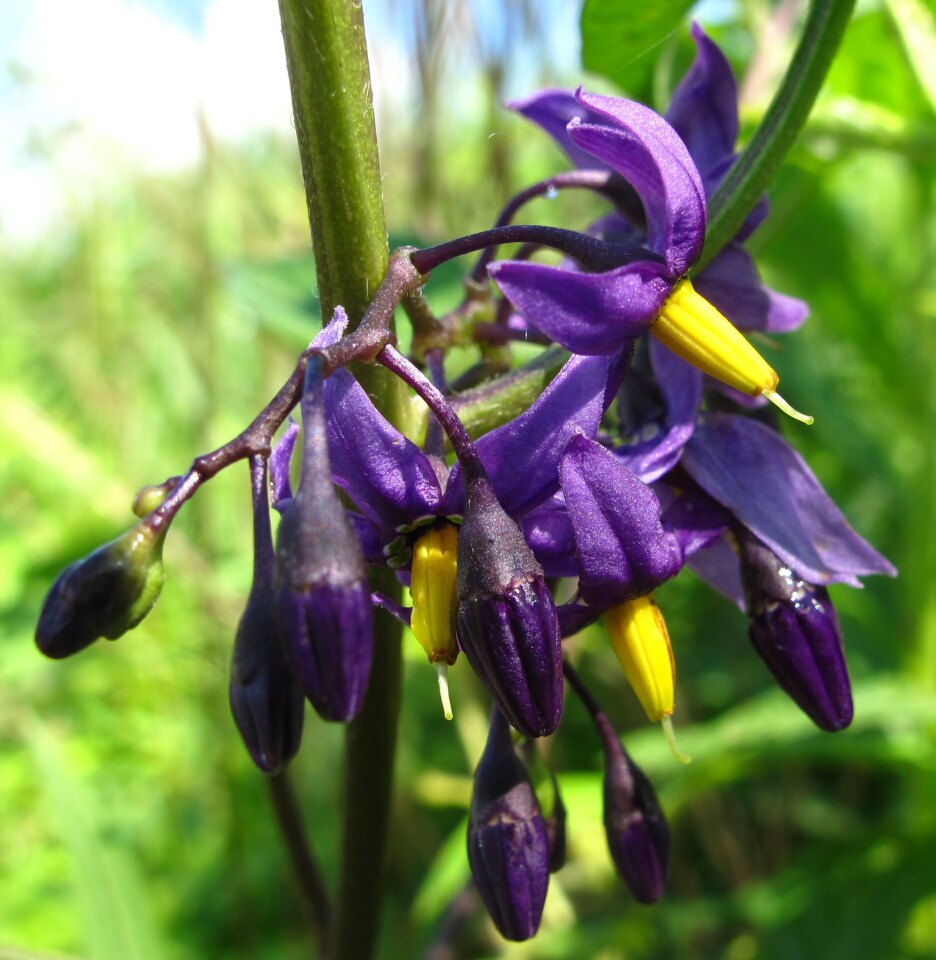
The small, deep purple and yellow flowers of Nightshade (Solanum dulcamara) identify a plant that should be treated with care. Nightshade, especially in its green immature fruits, contains steroidal alkaloids, which have caused poisoning in cattle and sheep. Humans may have been poisoned after ingesting immature berries.

This perennial will climb or scramble on other vegetation to a height
of 3 to 10 feet.


This perennial will climb or scramble on other vegetation to a height
of 3 to 10 feet.
05 June 2012
Spring Wildflowers
The Orange Hawkweed (Hieracium aurantiacum), also known as Devil's Paintbrush, is in bloom. With so many white and yellow wild flowers in bloom now, it's nice to see a bright red flower.

This wildflower is a member of the family Asteraceae and is native to alpine regions of central and southern Europe. There weren't too many bees around due to the cool weather, but this bee was busy checking out the flower.


The Field Hawkweed (Hieracium caespitosum) is also a member of the family Asteraceae native to Europe.

The bees were also busy with this yellow version of Hawkweed.

04 June 2012
Spring Wildflowers
Foxglove Beardtongue (Penstemon digitalis) is now in bloom. This member of the Snapdragon (Scrophulariaceae) family is a perennial native flower that grows from two to four feet tall, and prefers open woods or fields.

The Foxglove Beardtongue, also know as Foxglove Penstemon, looks a lot like foxglove, but it is actually a different family—the Penstemon family, while true digitalis is within the Plantaniaceae family. Beardtongues do not have the same pharmacological effect on humans, digitalis makes your heart beat more strongly.


The Foxglove Beardtongue, also know as Foxglove Penstemon, looks a lot like foxglove, but it is actually a different family—the Penstemon family, while true digitalis is within the Plantaniaceae family. Beardtongues do not have the same pharmacological effect on humans, digitalis makes your heart beat more strongly.


27 May 2012
Spring Wildflowers
While preparing a wildlife food plot at our cabin, I came across some "Yellow Toadflax". With a name like "Yellow Toadflax", some people prefer to call this flower Butter-and-eggs (Linaria vulgaris). This flower is native to most of Europe and northern Asia. It has also been introduced and is now common in North America.

This flower appears to be popular with members of the weevil family. I found several weevils on these flowers.


This flower appears to be popular with members of the weevil family. I found several weevils on these flowers.

25 May 2012
Spring Wildflowers
The Oxeye Daisy (Chrysanthemum leucanthemum) is one of the more common springtime flowers in our area. The daisy, along with many other common meadow flowers, was introduced from Europe and is not a native wildflower.


21 May 2012
Spring Wildflowers
The Birds-foot Trefoil (Lotus corniculatus) is starting to bloom. This perennial member of the pea family, Fabaceae, is used in agriculture as a forage plant, grown for pasture, hay, and silage.

Birds-foot trefoil is native to grassland temperate Eurasia and North Africa. It has become an invasive species in some regions of North America and Australia.


Birds-foot trefoil is native to grassland temperate Eurasia and North Africa. It has become an invasive species in some regions of North America and Australia.

19 May 2012
Buttercups
Maureen Brady's field, next to our barn, is a bright yellow from thousands of buttercups.


17 May 2012
Spring Wildflowers
The Common Fleabane (Erigeron philadelphicus) is starting to bloom.

This small, less than 1 inch, daisy like flower is a member of the Aster family, Asteraceae and are pink with yellow centers.


This small, less than 1 inch, daisy like flower is a member of the Aster family, Asteraceae and are pink with yellow centers.

15 May 2012
Spring Wildflowers
I found this patch of wild Forget-me-nots (Myosotis scorpioides) growing near the creek behind our house.

The flower is about 1/4 inches across but it's another flower that makes up for its small size with numbers.
This wildflower was introduced to the New England area from Europe and was extensively cultivated for ornamental use.


The flower is about 1/4 inches across but it's another flower that makes up for its small size with numbers.
This wildflower was introduced to the New England area from Europe and was extensively cultivated for ornamental use.

Subscribe to:
Posts (Atom)


