19 June 2012

Wildflower - Chicory

Chicory (Cichorium intybus) is a common roadside weed with a brilliant pastel blue flower. Chicory is a member of the Aster family and various varieties are cultivated for salad leaves or for roots which are baked, ground, and used as a coffee substitute.


In the United States chicory root has long been used as a substitute for coffee in prisons. By the 1840s the port of New Orleans was the second largest importer of coffee. Louisianans began to add chicory root to their coffee when Union naval blockades during the American Civil War cut off the port of New Orleans, thereby creating a long-standing tradition.

A close-up view of the center of the flower which attracts many insects.

17 June 2012

Spring Wildflowers

As I was driving by Miner's Pond I noticed this bright yellow flowering plant growing in the ditch next to the road. The plant was Yellow Loosestrife (Lysimachia vulgaris).


This member of the Primrose family (Primulaceae) is native to wetlands, damp meadows and forests of Eurasia and is considered invasive in some areas.

16 June 2012

Spring Wildflowers

As late spring turns into summer, the New York Ironweed (Vernonia noveboracensis) starts to bloom. This native wildflower has taken over a couple acres of my one hay field and must find the growing conditions perfect since it has stayed confined to this area of the neighborhood.
Link
Also known as Vein-leaf hawkweed, this plant is a member of the aster family, Asteraceae and is a favorite of butterflies and bees.

A Cabbage White Butterfly (Pieris rapae) on New York Ironweed.

15 June 2012

Spring Wildflowers

With the pipeline construction complete on Maureen Brady's property, I was glad to see the pipeline route had missed most of the Elderberry (Sambucus canadensis) bushes on her property.

The elderberry produces clusters of small white or cream-colored flowers in late spring; these are followed by clusters of small black or blue-black berries in the late summer.


The leaves, twigs, branches, seeds and roots contain a cyanide-inducing glycoside. Ingesting any of these parts in sufficient quantity can cause a toxic build up of cyanide in the body. "Herbal teas" made with elderberry leaves (which contain cyanogenic glycosides) should be treated with caution. However, ripe berries (pulp and skin) are safe to eat. Wine and jelly can be produced from the berries.

A close-up view of the small flowers in a cluster.

13 June 2012

Spring Wildflowers

Moth mullein (Verbascum blattaria) , is a species of flowering biennial belonging to the Scrophulariacea (Figwort) family. Native to Eurasia and North Africa, it has naturalized in the United States and most of Canada since its introduction.


Moth mullein gets its name from the fuzzy purple stamens, reminiscent of a moth's antennae.


Flower colors can be yellow or white, with red-purple stamens.

12 June 2012

Spring Wildflowers

Along with all the other yellow wildflower blooming this time of year, Sulfur Cinquefoil (Potentilla recta) may be overlooked. It is native to Eurasia but it is present in North America as an introduced species.

Link
Yellow Goat's Beard (Tragopogon pratensis) is a member of the Aster family (Asteraceae) and is native to Europe. This plant is also know as Meadow Salsify.

10 June 2012

Spring Wildflowers

I was working around our barn today when I noticed dozens of honeybees and bumblebees buzzing around Motherwort (Leonurus cardiaca). Motherwort is a herbaceous perennial plant in the mint family, Lamiaceae.


The fuzzy little flowers of Motherwort are much smaller than the honeybees.


It was introduced from Europe, with original populations stemming from Asia. It was brought to North America as a medicinal herb, used particularly for ailments of the heart and nervous system. Motherwort is a common weed in most north country gardens.


Butterflies

While photographing wildflowers I am sometimes lucky enough to have a butterfly hold still long enough for a picture. Here are some of the butterflies that cooperated.

European Skipper, (Thymelicus lineola)


Little Wood Satyr (Megisto cymela)


White Admiral (Limenitis arthemis arthemis)


Eastern Comma Butterfly (Polygonia comma)


08 June 2012

Frogs

While taking my daily walk around our pond I was able to get close to one of the many Bullfrogs that inhabit the pond.


Along with the Bullfrog I noticed lots of movement along the water's edge. A closer look revealed very little frogs taking their first steps out of the pond and onto dry land. The frogs were less than a 1/4 of an inch and some still had a small tall.


This one rested on a rock after leaving the pond.


Within minutes the little frogs were looking for a new home on dry land.


Pipeline Construction

With the hydrostatic testing of the Wesauking pipeline complete, the frac tanks used for water storage were removed toady.


A crew works on re-installing the check valve (yellow section of pipe) that was removed during the hydrostatic test. The check valve controls the directional flow of gas on the Wesauking Pipeline and prevents gas from flowing the 24 inch Wilmot Pipeline into the 12 inch Wesauking Pipeline.


Workers from Chesapeake monitor the 24 inch "pig launcher" on the Wilmot Pipeline.

07 June 2012

Dragonfly

While at our pond I had a dragonfly land close enough for me to get some pictures. Most of the time it is hard to get dragonflies to stop long enough to get a picture, but this one wasn't camera shy.


After a few quick shots I decides to move in for some close-up photos.


I was able to get the camera within an inch of the dragonfly for a real close-up shot. (Click on image to enlarge view)

Pipeline Construction

Natural gas is flowing in the Wilmot Pipeline. They were pushing a "pig" this afternoon using the pressure of natural gas. The pipeline pressure was over 1,200 PSI.


There is still some more work to do on the Wesauking Pipeline. The Wesauking "pig launcher" is currently not connected to the shut-off valve between it and the Wilmot Pipeline.

06 June 2012

Rainbow

Late this afternoon a brief "sun shower" passed through the area and I headed to our cabin to look for a rainbow. Just as I arrived at the cabin a double rainbow started to form.


Soon the upper rainbow faded away. The north end of the lower rainbow faded as the south end got brighter.


The last of the fading rainbow is reflected in our pond.

Spring Wildflowers

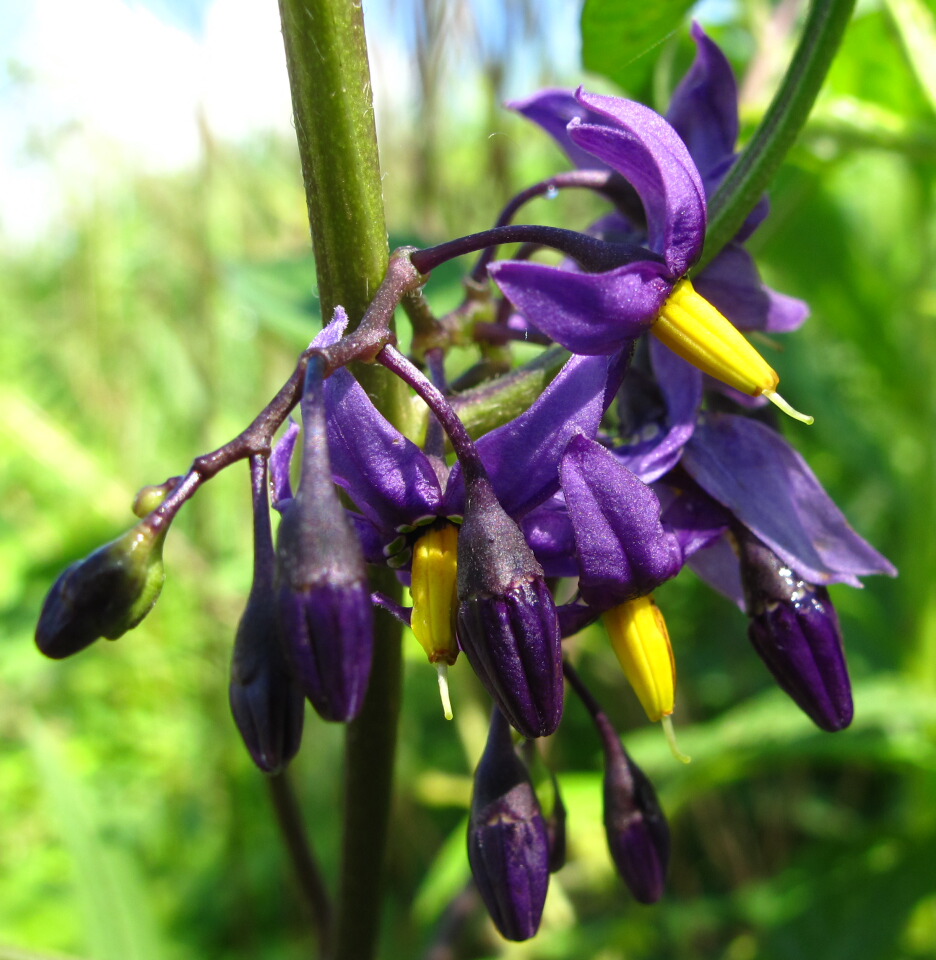
The small, deep purple and yellow flowers of Nightshade (Solanum dulcamara) identify a plant that should be treated with care. Nightshade, especially in its green immature fruits, contains steroidal alkaloids, which have caused poisoning in cattle and sheep. Humans may have been poisoned after ingesting immature berries.


This perennial will climb or scramble on other vegetation to a height
of 3 to 10 feet.

Pipeline Construction

The pipeline location markers were placed along the Wesauking Pipeline today. These markers identify the owner of the pipeline and phone numbers to call.


The markers are positioned directly over the pipeline route. The pipeline right-of-way is 25 feet on each side of the pipeline and the markers are positioned so at least 2 other markers are visible from any marker.