14 August 2016

Wildflower - Jewelweed

Jewelweed (Impatiens capensis) is an annual plant native to North America. Jewelweed prefers damp areas and is common in bottomland, ditches, and along creeks.


Jewelweed flowers are golden-orange with red splotches. Each flower is about an inch long.


The sap of jewelweed can be used used to relieve itching from Poison Ivy rashes.

12 August 2016

Wildflower - Allegheny Monkey Flower

The Allegheny Monkey Flower (Mimulus ringens) is a native perennial that prefers swampy areas and wet meadows. The small lavender, snapdragon-like flowers bloom all summer. We have a few of these flowers in the wetland behind our barn.


Each flower purportedly resembles the face of a smiling monkey (hence the common name).

11 August 2016

Wildflower - Wild Bergamot

Wild Bergamot (Monarda fistulosa), also known as Beebalm is a member of the mint family and a widespread native plant in much of North America.


Wild bergamot often grows in dry fields, thickets, and clearings, and commonly occurring in large clumps. The plants generally flower from June to September.


The common name of Beebalm is derived from it attracting many bees in search of the nectar in its narrow tubular flowers.


10 August 2016

Wildflower - Goldenrod

As we move into the late summer, the goldenrod is starting to bloom in the neighborhood. This patch of goldenrod is located in the wetland behind our barn. There are over 50 species of Goldenrod in North America and most of them are very similar and hard to tell apart.


The goldenrod flowers are very small and clustered into flower-heads on the long stalks.


While goldenrod is considered a weed to farmers and creates problems for people with allergies, it is extremely important to wildlife, especially insects that seek the nectar rich small flowers.


This patch of goldenrod was full of honey bees.

09 August 2016

Monarch Butterfies

I'm starting to see a few Monarch Butterflies in the neighborhood as they migrate north on their annual migration from Mexico. This is a male Monarch butterfly and can be identified by the black color on the ends of the wingtips, the females have orange wingtips.


As the Monarchs migrate north, several generations of Monarch butterflies are hatched and complete different sections of the migration. The Monarch butterflies born in this area after mid-August will be the generation that starts the southward migration to Mexico.

08 August 2016

Dragonfly - Eastern Amberwing

I try to visit our pond by the cabin daily since I never know what I'll find at the pond. Today's find was an Eastern Amberwing (Perithemis tenera) dragonfly. These are small dragonflies and this one is identified as a male by the uniformly orange/amber wings, whereas the female’s wings are clear with brown patches.

06 August 2016

Wildflower - Elecampane & Insects

Elecampane (Inula helenium) is not a common wildflower in our neighborhood but we do have a couple of patches growing on our property. Elecampane is a member of the sunflower family Asteraceae. It is native to Europe and Asia and naturalized in parts of North America.


While it isn't as popular or showy as other common wildflowers it does attract many different insects.


Several different types of bees are attracted to the Elecampane flowers.


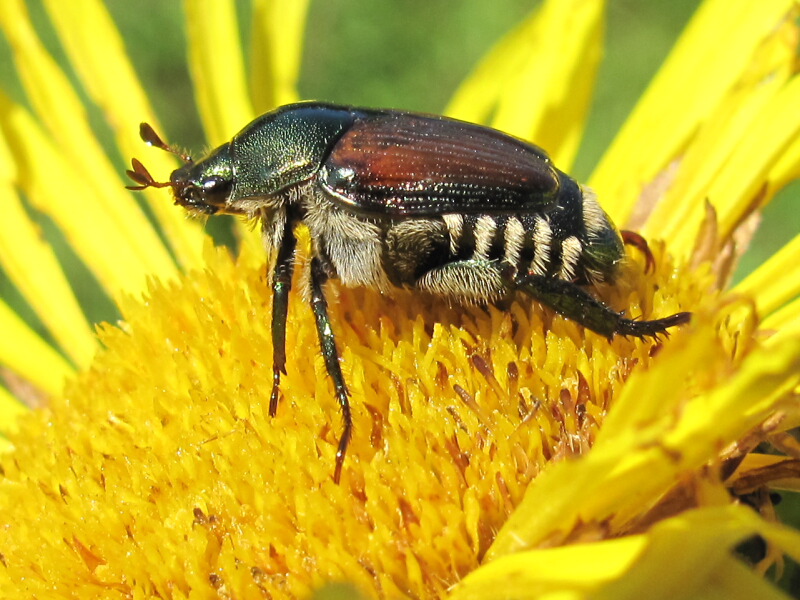
One good point of Japanese Beetles in the Elecampane ... they aren't eating my raspberries.


05 August 2016

Two-striped Grasshopper

I was photographing some wildflowers near our pond and came across this Two-striped Grasshopper (Melanoplus bivittatus) on some flowering goldenrod.


The two-striped grasshopper, is one of the most common hoppers in North America and get its name from the two distinct pale yellowish stripes along sides of top.

04 August 2016

Wildflower - Blue Vervain

This summer's dry weather has limited the Blue Vervain (Verbena hastata), which likes damp areas, to a few places such as around our pond.


This is a native wildflower and can produce hundreds of 1/8 inch flowers on each spike.


03 August 2016

Cooling Off at the Pond

I was working on some wildlife habitat near the pond at our cabin when a doe and her two fawns approached the pond.


The deer were at the pond during midday to get a drink and cool off.


02 August 2016

Bear Damage

I saw a bear with two cubs in the neighborhood about a week ago and it looks like a bear(s) may have damaged one of my apple trees.


I had drove by this tree at 2:30PM and it was Okay, but at 6:00PM this limb had been broken. I will need to do some tree surgery.


Our spring weather was hard on the apple crop and this tree was one of the few in the area with any apples.


Some of the claw marks on the apple tree. This damage may have been caused by the cubs since the claw marks are close to the ground and have narrow grooves and spacing.

01 August 2016

Rain ...

With little or no rain for the past two months, we received a slow/soaking 2.0 inches of well needed rain this weekend. We are still below average for rainfall this summer and can use another couple of slow/soaking rain storms like this one.


Just before the start of this rain I needed to dig a hole behind our barn with my backhoe and at 4 feet down there was no sign of moisture. The buckets of dirt came out of the ground as powder.

30 July 2016

How dry is It?

We have had very little rain in the neighborhood for the past 7 weeks and a storm went just south of us yesterday. I have been watering our garden for the last month and this is a photo of the ground between our lawn and the garden. The ground is so dry that 1/2 inch cracks have formed in the soil.

29 July 2016

Bullfrog

I went to the pond at our cabin today looking for wildflowers but the dry weather has reduced a lot of the flowers that prefer damp soil.

The water level at the pond was down and I found a bullfrog that was willing to pose for me. Notice the little flies on top of each eye.


The water level at the pond has been so low, for so long, that grass is starting to grow in the "mud flats" that were once the bottom of the pond.


28 July 2016

Why My Corn Won't Grow

We've had less than 2.5 inches of rain in the neighborhood for the past two months and my corn crop behind our barn has been struggling. Since the dry weather has effected other crops, the local deer have been stopping by my corn to check it out and have lunch. If you look close at the deer on the left you'll see it chewing on a corn stalk.


The corn at the bottom of this photo has been chewed off.