
12 June 2015
Baltimore Checkerspot Caterpillar
While looking in the fields near our cabin for fawns, I found my first Baltimore Checkerspot caterpillar for this year. This caterpillar may look mean, but it is harmless. This caterpillar will soon turn into the Baltimore Checkerspot butterfly, the state butterfly of Maryland, and hopefully I'll be able to get some photos of it.


11 June 2015
Feed Me !!!

A few days ago, this huge mouth was just one of four blue eggs in a nest.

Today the small nest is full of hungry redwing blackbird chicks.

The parents of the chicks weren't happy that I found the nest and "dive bombed" me several times while I was taking the family photo.

10 June 2015
Bullfrogs
I was at our cabin pond checking on the young geese and found this American Bullfrog (Lithobates catesbeianus) guarding his territory near the edge of the pond. The Bullfrog is the largest frog in North America with the females growing larger than the males and up to eight inches. Bullfrogs are most active at night and are voracious eaters that will eat just about any thing they can swallow. Bullfrogs have a deep, loud call which can be heard throughout the neighborhood on quiet nights.


09 June 2015
Spring Deer
The neighborhood deer have shed their winter coats and are taking advantage of the tender grass.

While the spring grass is plentiful, so are the flies.

This yearling buck's first set of antlers are developing quickly.


While the spring grass is plentiful, so are the flies.

This yearling buck's first set of antlers are developing quickly.

07 June 2015
Luna Moth
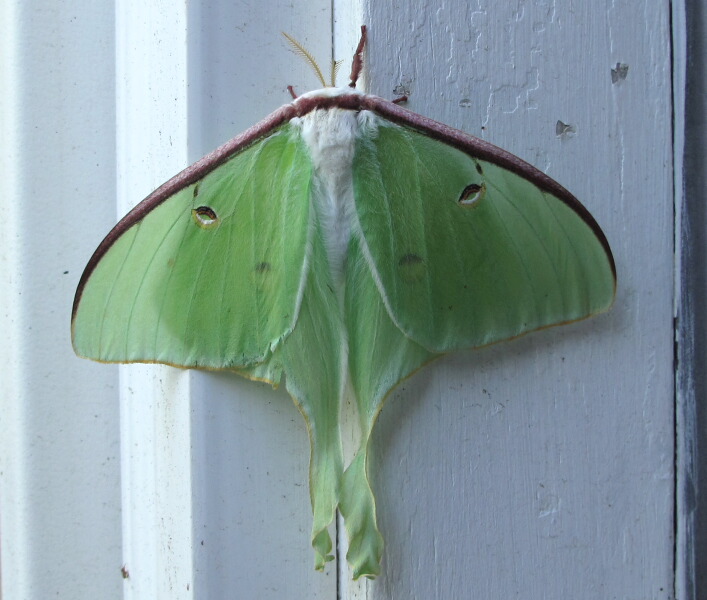
I found this luna moth (Actias luna) on our the entrance door to our garage one morning. The luna moth has a wingspan of up to 4.5 inches, making it one of the largest moths in North America.
Femal luna moths lay 400-600 eggs, 4–7 eggs at a time, on the underside of leaves, and they incubate for eight to thirteen days. In the northeastern United States the moths produce two generations each year. The first of these appear in April and May, and the second group can be nine to eleven weeks later.

Femal luna moths lay 400-600 eggs, 4–7 eggs at a time, on the underside of leaves, and they incubate for eight to thirteen days. In the northeastern United States the moths produce two generations each year. The first of these appear in April and May, and the second group can be nine to eleven weeks later.
06 June 2015
Wildflowers - Daisy
The wild daises (Leucanthemum vulgare) are starting to bloom and the neighborhood is showing patches of bright white in fields and along the roadside.
The daisy is native to Europe and an introduced plant to North America via gardens into natural areas where it is now a common weed. In some areas it is an invasive species forming dense colonies displacing native plants.

A close-up view of a bee on the center of a daisy.

The daisy is native to Europe and an introduced plant to North America via gardens into natural areas where it is now a common weed. In some areas it is an invasive species forming dense colonies displacing native plants.

A close-up view of a bee on the center of a daisy.

05 June 2015
Spring Fawns
This year's fawns are being born and I found this young fawn on our cabin property a couple of days ago. The fawn was only a day or two old and still had wobbly legs. In a couple of days the fawn will be bouncing around.
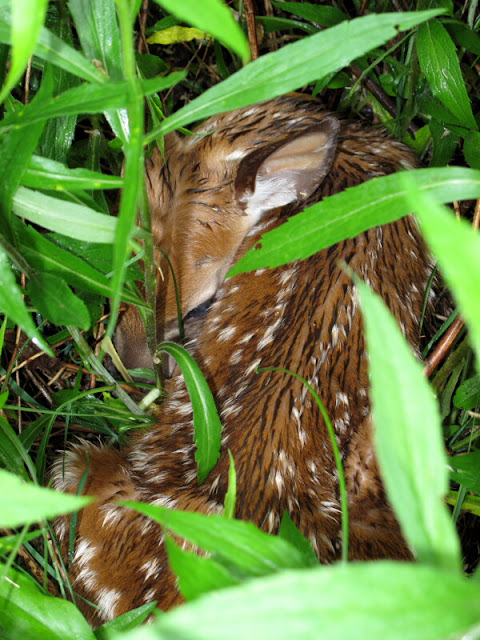
I spent a few hours walking around some of our fields and found this little guy curled up in the tall grass.
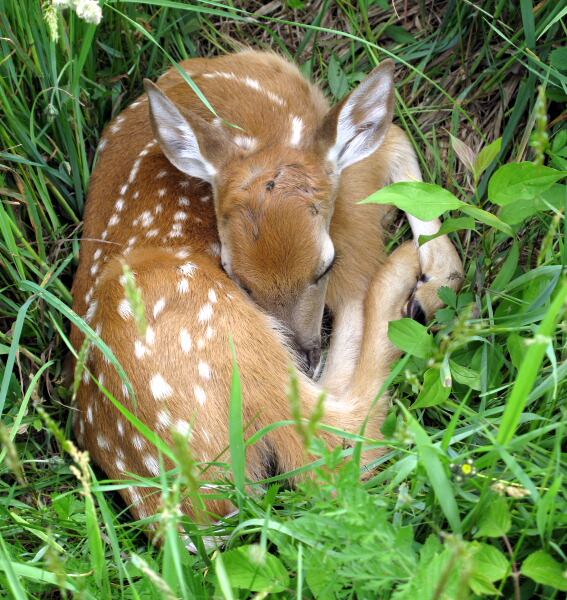
While I took photos the fawn lifted its head and watched me for a couple of minutes.

The fawns will try to stay motionless, but it is hard to do when you have a fly on your nose.
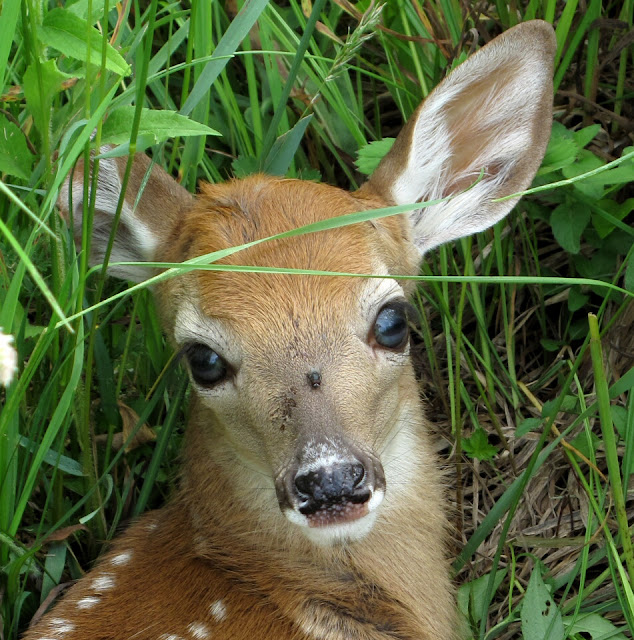

I spent a few hours walking around some of our fields and found this little guy curled up in the tall grass.

While I took photos the fawn lifted its head and watched me for a couple of minutes.

The fawns will try to stay motionless, but it is hard to do when you have a fly on your nose.

03 June 2015
Friends
I never know what I'll find as I drive around the neighborhood so I always try to have a camera with me. As I drove through our cabin property I saw this deer near our driveway with its friend, a redwing blackbird on its head.

As I watched, the bird would move back and forth from the deer's head to its back as the deer continued to graze.

The deer made no attempt to shake off the bird and even folded its ears down for the bird.

This may be a symbiotic relationship in which the bird removes insects from the deer. The deer gets rid of the bugs and the bird gets a meal.


As I watched, the bird would move back and forth from the deer's head to its back as the deer continued to graze.

The deer made no attempt to shake off the bird and even folded its ears down for the bird.

This may be a symbiotic relationship in which the bird removes insects from the deer. The deer gets rid of the bugs and the bird gets a meal.

31 May 2015
Matt & Alexandra's Wedding
On May 31st, 2015, our son Matthew Beebe and Alexandra Zill (Lexie) were married on a hilltop vista on our property.

Lexie, Matt and Colby.

Lexie and her Dad.

Matt & Lexie arrive at the reception in his classic Porsche.

The new Mr. & Mrs.

The best man, Chuck Beebe, toasting his brother.

Time for the wedding cake.

The reception was held in our barn and Matt & Lexie were still dancing at the end of the day.


Lexie, Matt and Colby.

Lexie and her Dad.

Matt & Lexie arrive at the reception in his classic Porsche.

The new Mr. & Mrs.

The best man, Chuck Beebe, toasting his brother.

Time for the wedding cake.

The reception was held in our barn and Matt & Lexie were still dancing at the end of the day.

23 May 2015
Young Buck
The warm spring weather has triggered this young buck's antlers to start growing and a small rack is now visible. He is also shedding his winter coat for a cooler summer coat.


22 May 2015
Goose Crossing
Stopped at our cabin today and was glad to see the geese were using the designated crossing area.


20 May 2015
Geese on the Pond
Within the last couple of days our cabin pond has been invaded by geese. For most of the spring these geese were nesting on the other side of Joyce Road on Miner's Pond.

The seven little goslings were hatched on Miner's Pond and within days the parents moved the little ones to our pond.


The seven little goslings were hatched on Miner's Pond and within days the parents moved the little ones to our pond.

18 May 2015
Wildflowers - Wild Strawberry
With warmer than normal spring days I took a walk through some of our wooded property and found several verities of wild flowers in bloom. This wild strawberry (Fragaria virginiana) blossom will change its appearance almost daily as a cone-shaped center enlarges to form the red berry in a few weeks.


12 May 2015
Spring Turkey Hunting
The Pennsylvania spring turkey season (bearded bird only ) opened on May 2 and I was up at 4:45AM to match wits with these birds. I've seen a few birds in the area during the spring, but the first task is to call the gobbles out of the woods and close enough to shoot.

One method to get the birds close is to use a decoy (on the right).

Not only will a decoy attract turkeys, other animals may come in to check out the decoys.

Not all birds that come to the decoys are legal to shoot. This hen turkey came within 3 feet of me, but they're not legal to shoot during the spring season.

Finally, after several early mornings of waiting, a small (tasty) gobbler came in and was shot several times with my digital camera.


One method to get the birds close is to use a decoy (on the right).
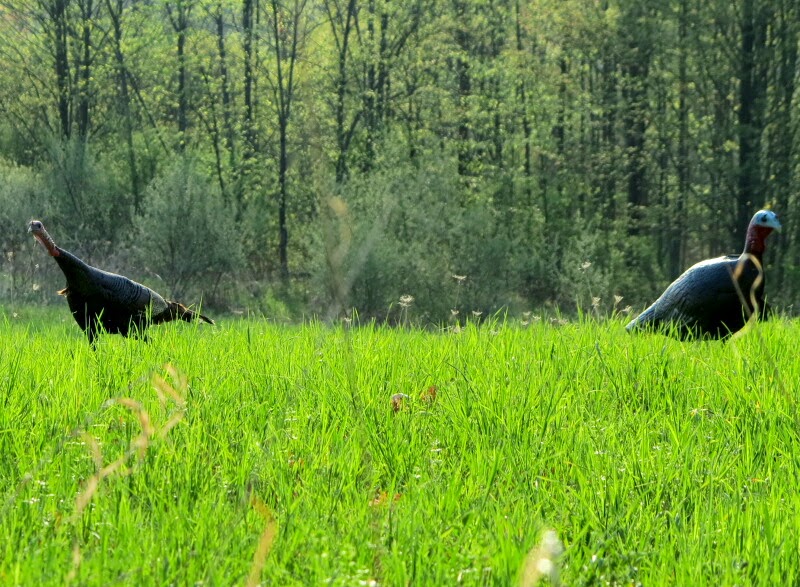
Not only will a decoy attract turkeys, other animals may come in to check out the decoys.

Not all birds that come to the decoys are legal to shoot. This hen turkey came within 3 feet of me, but they're not legal to shoot during the spring season.
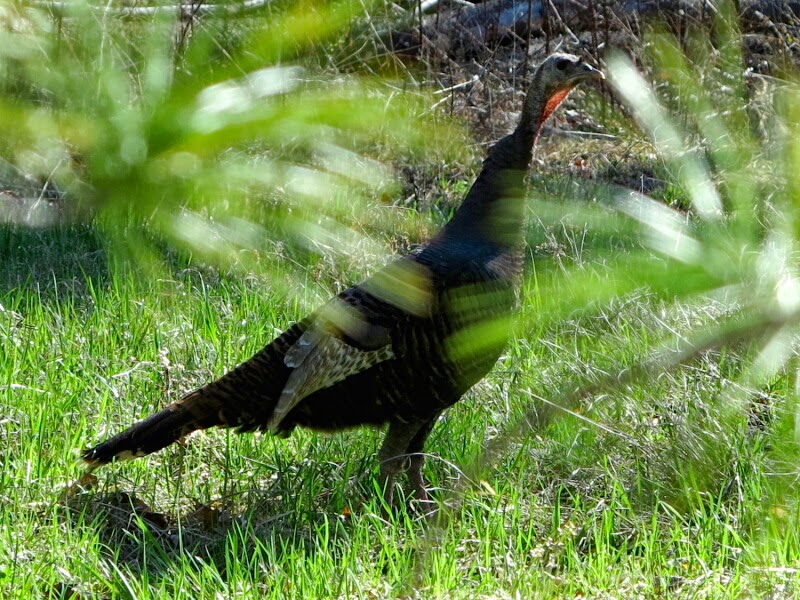
Finally, after several early mornings of waiting, a small (tasty) gobbler came in and was shot several times with my digital camera.

06 May 2015
Bats
We've been working at our barn for the last couple of weeks and today I noticed colony (group) of at least 4 bats huddled in a timber mortise on the underside of a large beam. The cooler overnight temperature may have forced them to huddle together for warmth. The bats remained in the same mortise all day as we worked with hammers and power tools under them


Subscribe to:
Posts (Atom)
