09 July 2016

Heat Wave

Our local weather forecaster has declared our current weather as a "Heat Wave" due to 3 consecutive days with the temperature at or above 90F. My weather station recorded a high of 91.8F today.

It was hot today and at midday I watch a deer walk briskly up the road to our cabin, then disappear over the crest of the hill. I drove to the cabin and found the deer had headed directly to our pond to cool off.

08 July 2016

Wildflower - Basswood

The Basswood trees (Tilia americana), also known as the American linden tree, are in full bloom in the hedgerow behind our barn. The 5-petaled fragrant, yellow-white flowers grow in small clusters. The basswood trees in our neighborhood bloom about every other year and it's hard to miss the perfumed air when the flowers are in bloom.


Honey bees and other nectar loving insects are attracted to the fragrant flower and thousands of wild honey bees were attracted to our trees.


A distinctive feature of the basswood is the tongue-like bract (a modified leaf) attached to each cluster of flowers. This leaf is lighter in color than the other leaves and has a dramatically different shape. No other tree in North America bears anything like it. In the fall the flowers in the clusters will be replaced with with the basswood seeds and bract leaf will break loose and the wind will carry the seeds away from the tree.

07 July 2016

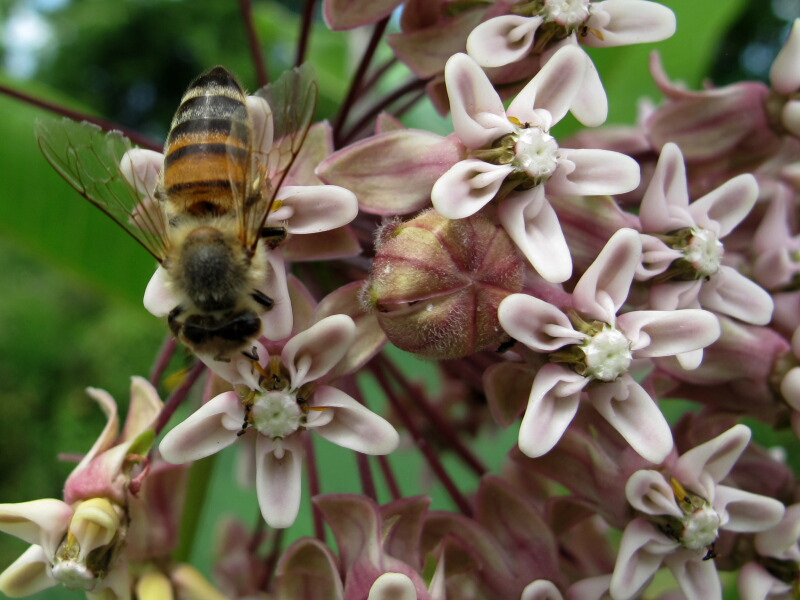
Milkweed and Bees

I'm starting to keep track of the time of year by which wildflowers are in bloom. We're in the early days of milkweeds now.

Most people associate milkweed with the Monarch Buttery but it attracts many insects with its large clusters of tiny five lobed flowers. Here are a few photos of bees (mainly wild honey bees) on milkweed flowers.


06 July 2016

Red Milkweed Beetles

The milkweed plants are starting to bloom in the neighborhood, and they are swarming with different insects. While some insects, such as bees are after the flower's nectar, other insects like the Red Milkweed Beetles (Tetraopes tetrophthalmus) are able to eat the toxic milkweed plant.


Adult Red Milkweed Beetles eat milkweed leaves, buds, and flowers. Like some other milkweed leaf feeders, they sever leaf veins “upstream” of their feeding site in order to minimize their exposure to the milkweed’s sticky latex.

04 July 2016

Wood Frog

I never know what I'll find as I wander the neighborhood. Today's find was a Wood Frog (Lithobates sylvaticus). Most frogs are commonly found near water but the Wood Frogs spend a lot of time on land, the toes on their front legs are not fully webbed. It has been very dry this year and I found this Wood Frog at the edge of our woods.


The Wood Frog is most easily recognized by its "robber mask." This black band stretches past both eyes to the eardrums. They also have dorsolateral ridges, two raised lines running down their back.

Adult Wood Frogs are usually brown, tan, or rust-colored, and are easily camouflaged into the leaf litter.


Wood Frogs are one of the first frogs to breed in early Spring. Their calls, which sound like a "quack," can be heard around water that's near woods.

03 July 2016

Baby Barn Swallows

I was in the upper level of our barn and had a couple of Barn Swallows "dive bomb" me. I stated looking and found the bird's nest tucked up in some rafters on top of an electrical box.


As I was taking some photos one of the parents arrived (at the left) with a mouth full of insects to feed the chicks. The parent was only about a foot from my camera.


In between the feedings the 5 baby birds would rest.


The parents on an old hay lift rope. The female is on the top and the male is on the bottom.

02 July 2016

Fawns

The neighborhood fawns are getting bolder and easier to find along the edge of the road. This fawn, and its twin that wouldn't pose, were along the road to our cabin ...


But mother was close by.


This fawn crossed the driveway to our cabin and then stood in the tall weeds to watch me.

30 June 2016

Baby Robins

Back on June 17th I found a robin's nest in my grape vines. I decided to document the hatching of the new baby robins.


No activity in the nest until June 25th when the first chick hatched. The small chick must have been only hours old and was unable to move its head from between the other two eggs.


By the afternoon of the first day the chick was able to move its head. There are visible cracks on the egg on the right.


By the morning of June 26th a second chick has hatched.


June 27th and the third egg still hasn't hatched but both of the other chicks were able to hold their heads up and request food. Both chicks are now much larger than the third egg.


Another day and the first two chicks have grown rapidly and the first signs of pin feathers can be seen on the tips of the wings. The third egg still hasn't hatched and the first two chicks are now big enough to cover the egg.


It's now 5 days since the first chick hatched and it's not looking good for the third egg. The first two chicks are turning darker as they develop more pin feathers.

28 June 2016

Don't Let Turtles Play in a Road !

I found this Eastern Painted Turtle (Chrysemys picta) in Joyce Road near the driveway to our barn. The turtles are laying their eggs this time of year and his turtle must have just laid its eggs since it has fresh mud on the back of its shell.


We've had a couple of turtle/vehicle collisions in this section of road during the past week and the turtles are not winning. If you see a turtle in a road please move it to a safe location off the road.

Shoo, Fly, Don't Bother Me

The warm weather is here and so are the flying insects. The local deer, and other livestock, are having a hard time avoiding the flies.

27 June 2016

Exploring the Neighborhood

I went up to our barn this morning and found these two fawns scoping out the property. As I watched the two fawns, they looked into the upper level of the barn and then moved to the lower level "courtyard".


They then headed toward our garden, which is surrounded by an electric fence. They continued around to the back of the barn to complete a 360 around the barn.


They will start learning the layout of their home territory at an early age and build a mental map of the neighborhood as their explore. This exploring of the neighborhood will help them build predetermined escape routes to elude predators in the future.

25 June 2016

Fawn & Geese

This year's fawns are starting to explore the neighborhood and look for new friends to play with. While mowing the lawn at our cabin I noticed a fawn getting a drink from the pond as some of this year's geese were practicing their synchronized swimming... Or maybe the geese were sending a message to the fawn.


Just before this photo was taken, a flock of 16 geese were in the hay field catching bugs when this fawn ran out of the bushes at full speed and into the flock of geese scattering them. The geese are keeping their distance for this guy.

23 June 2016

Wildflower - Carolina Rose


The Carolina Rose (Rosa carolina), also known as a pasture rose, are starting to bloom in the neighborhood. The Carolina Rose is a shrub in the rose family native to eastern North America.

The Carolina Rose is a small, scrambling shrub with 2" wide-open single blooms with five bright pink petals and stems with straight, needle-like thorns.


21 June 2016

Wildflower - Elderberry

The blossoms of the Common Elderberry (Sambucus nigra canadensis) are just starting to open on the bushes in our neighborhood. The elderberry flowers are very small, less than 1/4 inch and form umbel-like panicles of flowers that span 3-10" across. Each of these small flowers in the flower cluster will form a small black/blue-black berry in the cluster. These berries are enjoyed by birds and other wildlife and also used to make jam and wine.


A close-up view of the flowers.

19 June 2016

Farmer Ants

I was checking my grape vines at the barn property and noticed some discolored leaves on a milkweed plant. After a closer inspection of the leaves I found the discolored area of the leaves were covered with aphids and some ants.


Ants and aphids share a well-documented relationship of mutualism. Ants feed on the sugary honeydew left behind by aphids. In exchange, the ants protect the aphids from predators and parasites. The aphids look to be positioned in rows lined up with the veins in the leaf.


Different leaves had different size aphids.